
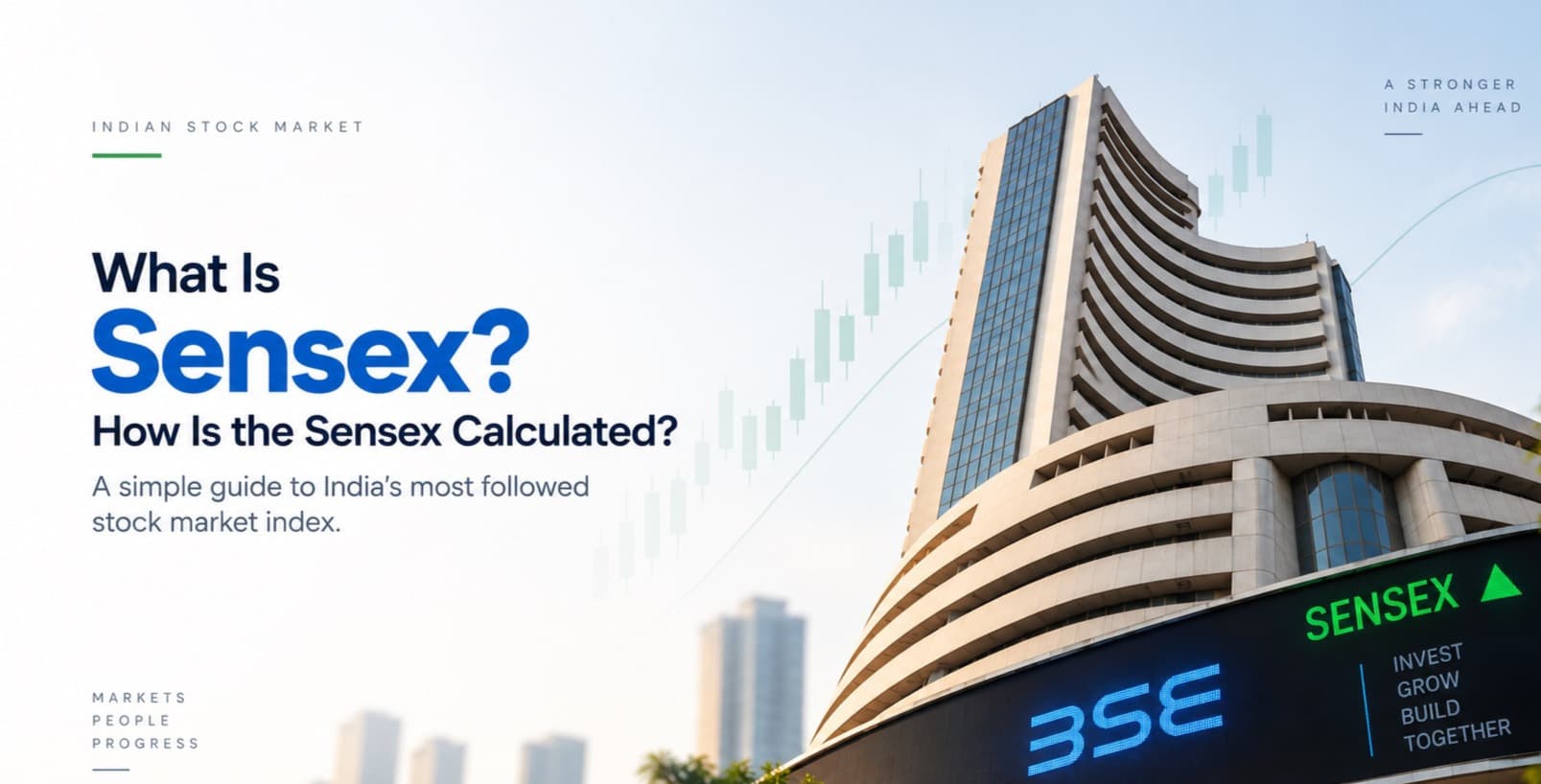
What Is Sensex? How Is the Sensex Calculated?
Sensex is one of the most widely followed stock market indices in India. You will often see headlines such as “Sensex gained 500 points” or “Sensex fell sharply today.”
But what does that number actually represent?
Is Sensex simply the average price of 30 stocks? Why do some companies have a bigger impact on Sensex than others? And how is the Sensex value calculated?
The answer comes down to free-float market capitalisation.
In this guide, we explain what Sensex is, how it is calculated, how companies are weighted, how stocks are selected, and why Sensex can rise even when many stocks in the market are falling.
What Is Sensex?
The BSE SENSEX, commonly called Sensex, is the flagship benchmark index of BSE Ltd.
It tracks 30 large, liquid and financially sound companies listed on BSE across key sectors of the Indian economy.
The word SENSEX comes from Sensitive Index.
Unlike an index where every stock has the same weight, Sensex uses a free-float market capitalisation methodology. This means larger companies with greater free-float market value generally have a larger influence on the index.
So, the 30 companies in Sensex do not contribute equally.
A large movement in a heavily weighted company can have a much greater effect on Sensex than the same percentage movement in a smaller-weighted constituent.
Sensex is commonly used for:
- Tracking large Indian companies
- Understanding broad movements in the Indian equity market
- Comparing portfolio performance
- Creating index-based investment products
- Trading index derivatives
- Understanding market sentiment
Why Is Sensex Important?
If you are new to the stock market, you may think Sensex is simply a number that goes up and down during market hours.
It is more useful to think of Sensex as a market benchmark.
When Sensex rises, it generally means that the combined free-float market value of its constituent companies has increased relative to the index's base and divisor.
When Sensex falls, the opposite is generally true.
However, Sensex does not represent every company listed in India.
There are thousands of listed securities across the Indian market, while Sensex contains only 30 companies. Because the stocks have different weights, a few large constituents can have a substantial effect on the index.
This is why Sensex can sometimes rise even when several individual stocks are falling.
Understanding its calculation makes this easier to understand.
How Is Sensex Calculated?
A common misunderstanding is that Sensex works like this:
Add the prices of 30 stocks and divide the result by 30.
That is not how Sensex is calculated.
Sensex uses the free-float market capitalisation methodology.
In simplified form:
Sensex = Total Free-Float Market Capitalisation of Sensex Constituents ÷ Index Divisor
The divisor helps maintain continuity in the index when changes such as stock replacements, corporate actions or changes in capital occur.
This means that a bonus issue, stock replacement or similar corporate action does not automatically create a misleading jump or fall in the index.
What Is Market Capitalisation?
Before understanding free-float market capitalisation, you need to understand market capitalisation.
Market Capitalisation = Current Share Price × Total Outstanding Shares
For example, imagine a company has:
- 100 crore shares
- Share price = ₹500
Its market capitalisation would be:
₹500 × 100 crore = ₹50,000 crore
So the company's total market value would be ₹50,000 crore.
But Sensex does not simply use the entire market capitalisation of each company.
It uses free-float market capitalisation.
What Is Free-Float Market Capitalisation?
Not all shares of a company are necessarily available for regular trading by the public.
For example, a company may have shares held by:
- Promoters
- Strategic investors
- Governments
- Controlling shareholders
- Other holdings that are restricted or not normally available for public trading
The portion considered available for public investment is referred to as the free float.
The simplified calculation is:
Free-Float Market Capitalisation = Market Capitalisation × Free-Float Factor
For example, suppose a company has:
- Total shares = 100 crore
- Share price = ₹500
- Total market capitalisation = ₹50,000 crore
- Free-float factor = 60%
Then:
₹50,000 crore × 60% = ₹30,000 crore
So ₹30,000 crore would be used as the company's free-float market value for index-weighting purposes rather than the entire ₹50,000 crore.
This is important because companies with different ownership structures can therefore have different index weights.
How Does Sensex Weight Each Stock?
The 30 Sensex companies do not receive an equal 3.33% weight.
Their weights are based on their float-adjusted market capitalisation.
In simplified terms:
Stock Weight = Company's Free-Float Market Capitalisation ÷ Total Free-Float Market Capitalisation of Sensex
Imagine Sensex contained only three companies:
- Company A → 50% weight
- Company B → 30% weight
- Company C → 20% weight
Now suppose:
- Company A rises 4%
- Company B falls 1%
- Company C falls 2%
The approximate index movement would be:
(50% × 4%) + (30% × -1%) + (20% × -2%)
= 2% − 0.3% − 0.4%
= +1.3%
So the index could rise even though two of the three companies fell.
The real Sensex calculation involves the complete index methodology and divisor, but this simplified example shows why weight matters.
Why Can Sensex Rise When Many Stocks Are Falling?
This is one of the most important things to understand about a market index.
Imagine that several smaller stocks in the broader market are falling.
At the same time, a few heavily weighted Sensex companies rise significantly.
Because those larger companies have greater influence on the index, their gains can offset declines from other constituents.
As a result:
Many stocks can be down while Sensex is still up.
The opposite can also happen.
A few heavily weighted companies can fall sharply and pull Sensex lower even when several other constituents are rising.
That is why looking only at the Sensex number does not always tell you how every stock in the market is performing.
Market breadth, sector performance and individual stock weights can provide additional context.
How Are Sensex Companies Selected?
Sensex is not simply a list of the 30 companies with the highest share prices.
BSE uses eligibility and selection criteria to determine which companies can become constituents.
The eligible universe and selection methodology consider factors such as market capitalisation, trading activity, liquidity, existing constituent status and sector representation.
The selection process aims to maintain a 30-company index representing large and liquid companies across important areas of the Indian economy.
So a company's share price alone does not determine whether it becomes part of Sensex.
How Often Does Sensex Change?
Sensex constituents are reviewed and rebalanced according to the rules established by BSE Index Services.
Periodic reviews and specific eligibility and selection criteria are used to determine additions and deletions.
When a company no longer satisfies the relevant requirements, it can be removed from the index.
Similarly, another company that satisfies the criteria can be added.
This allows the index to evolve as the market changes.
What Happens When a Stock Enters or Leaves Sensex?
Changes in an index can affect market participants that track the index.
Suppose a company is added to Sensex.
Index funds and other products designed to track the index may need to adjust their holdings so that their portfolios reflect the new composition.
If another company is removed, those portfolios may reduce or remove their exposure to that stock.
However, index inclusion itself does not automatically tell you whether a stock is attractive as an investment.
The index follows defined rules for determining its constituents.
Sensex Base Date and Base Value
Sensex has a long history in the Indian stock market.
Its base period is 1978–79, and its base value is 100.
Sensex was officially launched on 2 January 1986.
The base value of 100 is essentially the starting reference point used to measure changes in the index over time.
It does not mean that the current Sensex level is an average of the original stock prices.
Instead, the index reflects changes in the market value of its constituents through its methodology and divisor.
Why Is Sensex Called a Benchmark?
A benchmark gives investors a reference point for measuring market performance.
For example, suppose a portfolio gained 10% during a particular period.
To understand that performance, an investor may compare it with an appropriate market benchmark over the same period.
Sensex can serve as one such reference for portfolios focused on large Indian companies.
It is also used as the basis for various index-linked financial products and derivatives.
However, a benchmark should match the type of portfolio or strategy being evaluated.
A portfolio focused heavily on small-cap companies, for example, may behave very differently from an index containing 30 large companies.
Sensex vs Nifty 50
Sensex and Nifty 50 are often mentioned together, but they are different indices.
| Feature | Sensex | Nifty 50 |
|---|---|---|
| Exchange | BSE | NSE |
| Number of companies | 30 | 50 |
| Purpose | Large-cap market benchmark | Large-cap market benchmark |
| Weighting | Free-float market capitalisation | Free-float market capitalisation |
| Base period | 1978–79 | November 3, 1995 |
| Base value | 100 | 1,000 |
The biggest structural difference is the number of constituents and the exchange from which the companies are selected.
Because the constituent lists and weights are different, Sensex and Nifty 50 can show different daily movements.
A day when Sensex rises does not necessarily mean Nifty 50 will rise by exactly the same percentage.
What Factors Can Move Sensex?
Sensex responds to changes in the prices of its constituent companies.
Those stock prices can be influenced by many factors, including:
- Corporate earnings
- Interest rates
- Inflation
- Economic growth
- Foreign institutional flows
- Domestic institutional flows
- Crude oil prices
- Currency movements
- Global equity markets
- Bond yields
- Government policies
- Geopolitical developments
- Investor expectations
The important point is that Sensex itself does not create these movements.
It reflects the combined price movements of its constituent companies according to the index methodology.
What Should You Watch Along With Sensex?
Looking only at the Sensex level can provide an incomplete picture.
You can also look at:
1. Market Breadth
Check how many stocks are rising versus falling.
A market where most stocks are participating in a move can look very different from one where only a few large companies are driving the index.
2. Sector Performance
Different sectors can behave differently.
Financial services, information technology, energy, automobiles, pharmaceuticals and consumer companies may respond differently to economic and market developments.
3. Heavyweight Stocks
Because Sensex uses free-float market-cap weighting, larger-weighted companies can have a greater impact on the index.
4. India VIX
India VIX is commonly used as an indicator of expected market volatility.
It can provide additional context during periods of sharp market movements.
5. Global Markets
Indian equities can also react to developments in global markets, including US equities, crude oil, the US dollar and global bond yields.
Sensex Price Index vs Total Return Index
There is another important distinction when measuring investment performance.
A price index primarily reflects changes in the prices of the underlying stocks.
A Total Return Index (TRI) also accounts for dividends, assuming those dividends are reinvested according to the index methodology.
This difference matters when comparing the performance of a portfolio that receives dividends.
For a fair comparison, the benchmark should match the type of return being measured.
Is Sensex the Entire Indian Stock Market?
No.
Sensex tracks only 30 companies.
India's equity market contains thousands of listed securities across large-cap, mid-cap and small-cap companies.
Therefore, Sensex should be viewed as a benchmark representing a selected group of large and liquid companies rather than a complete picture of every listed company in India.
This is also why the broader market can sometimes behave differently from Sensex.
Key Takeaways
Sensex is more than just a number displayed on a trading screen.
Here are the main points to remember:
- Sensex is the flagship benchmark index of BSE.
- It tracks 30 large, liquid and financially sound companies across key sectors.
- Sensex uses free-float market capitalisation for weighting.
- The stocks in Sensex do not have equal weights.
- Free-float market capitalisation considers the portion of a company's shares available for public investment.
- Sensex is calculated using the total free-float market capitalisation of its constituents and an index divisor.
- Its base period is 1978–79, with a base value of 100.
- Sensex was launched on 2 January 1986.
- Changes in constituent companies and corporate actions are handled through the index methodology and divisor adjustments.
- Sensex can rise even when several individual stocks are falling because its constituents have different weights.
- Sensex and Nifty 50 are different indices with different constituent lists.
- Sensex is a benchmark for a selected group of large companies, not the entire Indian stock market.
Once you understand how Sensex is constructed, its daily movements become easier to interpret.
Instead of simply asking “Why did Sensex rise?”, you can look deeper:
Which companies moved? Which sectors contributed? How were the heavyweight stocks performing? And what broader market factors were driving those moves?
That gives you a much clearer picture of what the Sensex number actually represents.
Disclaimer: This article is for educational and informational purposes only. It is not investment advice or a recommendation to buy or sell any security. Market investments involve risk, and past performance does not guarantee future results.